| Return postage will be paid by | Buyer |
|---|---|
| Returns Accepted | Returns Accepted |
| After receiving the item, your buyer should cancel the purchase within | 30 days |
| Type | Interface Card |
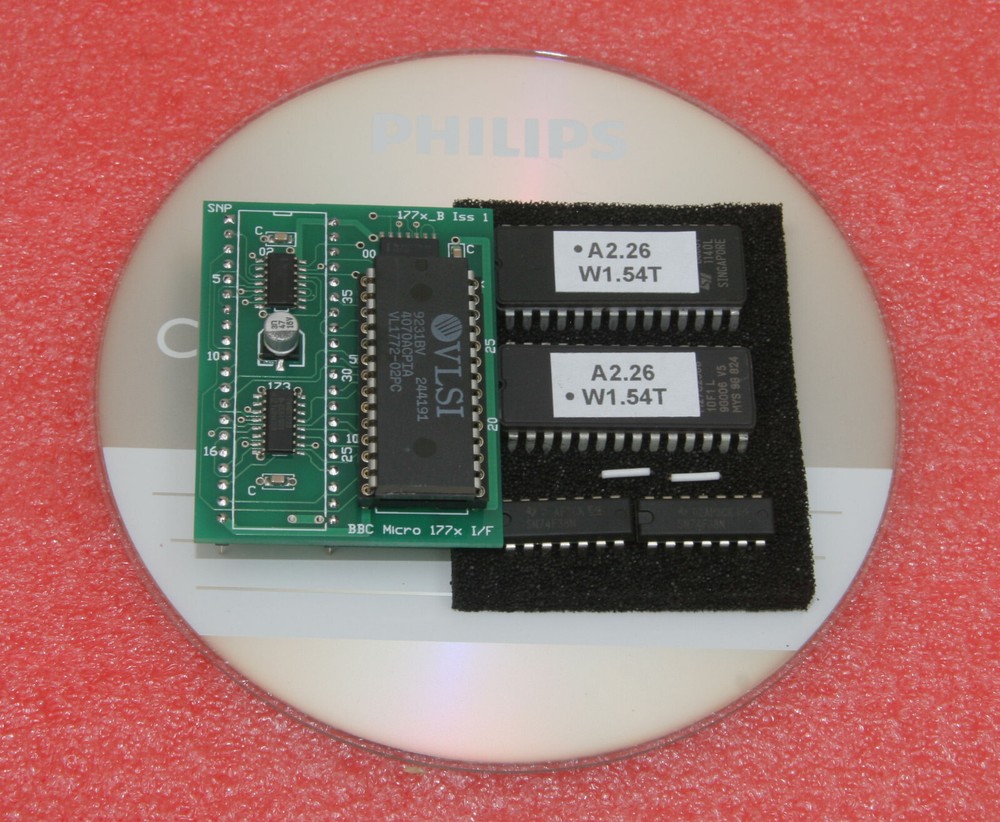
Check the listing for details. ACORN BBC MICRO MODEL B 1770 OR 1772 FLOPPY DISK UPGRADE KIT INTERFACE GOTEK. Condition: New. Listed at 44.98 USD. IFEL - Est.1984 Suits BBC Model B only Floppy disk interface kit based on the 1772 controller chip 1772 is socketed to allow easy change to 1770 Use with 3.5", 5.25" drives and Gotek Can be used with DFS (Disk Filing System) or Advanced DFS (DFS ROMs supplied) Supplied with two DFS ROMs (Acorn 2.26 & Watford 1.54T) Manuals for the Acorn DFS, ADFS and Watford DFS are all supplied as PDF files on the CD The original Model B did not usually come with any kind of floppy drive. Acorn designed the floppy drive system around the 8271 disk controller chip. The 8271 is a fairly solid and reliable device but is now quite hard to obtain (it's been obsolete for years) and is also limited to single density operation. The newer 1772 controller chip has a number of advantages but, having only 28 pins instead of the 40 on the 8271, it is not a drop-in replacement. An adapter board like this is therefore needed in order to use the 1772 or 1770 chip. The kit includes everything you need to prepare a Model B computer for connecting up either the older 5.25" or the relatively modern 3.5" drives. It can also be used with Gotek floppy emulators. The drives themselves are not included. 1770/1772 differences The 1770 and 1772 are actually very similar. In fact, the 1772 chip on this module is in a socket and could easily be swapped for the 1770 with no other changes needed. In use, a series of 'step pulses' are sent from the 1770/1772 to the floppy drive in order to move the read/write head to a different track. These step pulses are only around 10 microseconds wide. The step rate is much longer (typically a few milliseconds) and is simply the time delay between one step pulse and the next. The two chips differ slightly in the available 'head step speeds'. The 1770 offers 6ms, 12ms, 20ms and 30ms (default) step speeds. For the 1772 the corresponding delays are 6ms, 12ms, 2ms and 3ms (default). As you can see, the default speed for the 1770 is 30ms but for the 1772 it is 3ms, ten times faster. 30ms on the 1770 is tediously slow - it takes nearly 2.5s (about 80 times 30ms) to move from track 0 to track 79 in an 80 track drive. Luckily it's also completely unnecessary, as virtually all drives available for Acorn machines will work at 12ms. Very early drives might struggle to work reliably at 2ms step speeds ('modern' 3.5 inch drives and Gotek floppy emulators will be fine). There are two ways of changing the step speed. One is by means of links on the keyboard although you need to remove the lid to access them. Search 'DIP Switch' on eBay to see the type of product required. Another is by means of a keyboard command, specifically a *FX call. How to do this is detailed with the kit. Generally there is no difference in data transfer rates between the 1770 and 1772 when reading disks, ignoring the time taken to move to a particular track as outlined above. Unlike some 177x modules, this unit can readily be changed to the 1770 because the 1772 is in a socket. It is a straightforward chip swap but it is unlikely to be necessary to downgrade to the 1770. It would not have been sensible for the 1772 designers to produce a chip which was so fast that hardly any floppy drives would work with it. By allowing it to be slowed down in software it would then appeal to a wider market. Furthermore, Acorn themselves started supplying the 1772 chip with their disk interface kit and even fitted the 1772 to some Master 128s. They wouldn't have done if none of the drives available at the time could be used with it. Statements that the 1772 won't work because it's too fast and will cause issues are misleading and do not tell the whole story - the chip can be slowed down if needed. Supplied with Acorn DFS 2.26 and Watford Electronics DDFS 1.54T The firmware needed to read from and write to floppy disks is supplied on EPROM. Two separate ROMs are supplied with the kit, the Acorn 2.26 DFS and the Watford Double Density 1.54T system (DDFS). Both are very similar and either DFS can usually read disks which have been formatted with the other. Two notable exceptions to this are that the Watford system can format a disk with a 62-file catalogue, this being double the normal 31-file limit. The Acorn DFS will not be able to read all the files from disks which have been formatted in this way. Additionally, the Watford DDFS can format disks in double density mode to give an increased storage capacity per disk. Again, the Acorn DFS will not be able to read disks which have been formatted like this. On the other hand, the Watford DFS can read all disks formatted with the Acorn 2.26 system (and many others too). It can also read disks which have been formatted with the older 8271, the only exception being disks (usually games) which have deliberately used the 8271 in some form of copy protection mode. On the face of it, the Watford DDFS would be the filing system of choice and indeed many users may prefer it. However, what suits one user may not suit another and for this reason BOTH systems are included. Try one and then the other, and stick with the one that suits you best. Both DFS EPROMs are yours to keep, there is no requirement to send one of them back. It is possible to install both the Acorn and Watford EPROMs simultaneously in the same machine, always assuming you have enough ROM sockets. There are some disadvantages in this arrangement and the information on the CD explains these problems and the various ways to overcome them. You will almost certainly find that 99.9% of the time you will only need one DFS ROM installed.ROM board compatibility The 1770/1772 upgrade kit is compatible with many of the ROM expansion boards from the 1980s. The easy way to check is just to quickly remove the lid of the computer and look at the two large chips by the keyboard ribbon cable. If there's nothing covering the rightmost large chip (a 6522), then the 1770 upgrade should fit without any issues. The modern expansion board shown in one of the pictures is not included. It is available from IFEL as a separate item. ADFS filing systems The 1770/1772 board can also support the Advanced Disk Filing System (ADFS). Normally, there is no actual EPROM included with the kit but ADFS ROM data is supplied on the CD. If you would prefer an ADFS EPROM instead of one of the two DFS EPROMs, it can be provided at no extra cost - just request it at the checkout. Soldering/track cutting. Some Model B motherboards, for example Issue 3 or earlier, may need some fairly straightforward circuit board work carried out. It can depend on what's in the machine already. The same was true of the 8271 upgrade and it is not a requirement that is unique to the 177x system. The third photo shows the daughterboard installed in an Issue 3 Beeb. A short length of green wire (part of the work needed and supplied with the kit) is visible by the Acorn logo. Money-back guarantee The product is covered by a 1 year guarantee. Additionally, most eBay Buy It Now sales are covered by the Distance Selling Regulations (DSR). In essence this gives you a 30-day period in which to return the goods for any reason whatsoever. If you wish to return this item in the 30-day period then you will receive a full refund of the amount paid. The cost of returning the item to us is to be borne by the purchaser unless, of course, the item is actually faulty in which case we will refund any reasonable postage costs as well.
You may also like