| All returns accepted | ReturnsNotAccepted |
|---|---|
| Exploration Missions | Space Shuttles |
| Type | NASA Patch |
| Signed | No |
| Theme | Astronauts & Space Travel |
| Country/Region of Manufacture | Unknown |
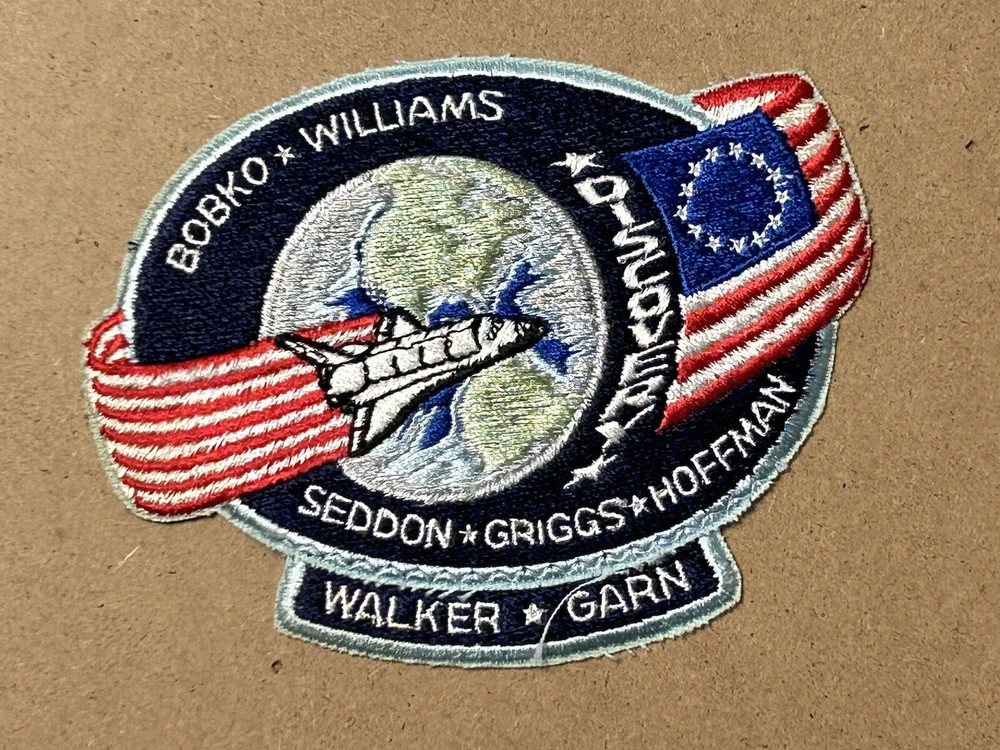
Check the listing for details. NASA Space Shuttle Discovery STS-51D Mission Patch. Condition: Used. Listed at 8.50 USD. NASA Space Shuttle Discovery STS-51D Mission Patch Patch is approximately 5.25" x 4". During STS-51-D, the shuttle crew deployed two communications satellites: Telesat-I (Anik C1) and Syncom IV-3 (also known as Leasat-3); both were Hughes-built satellites. Telesat-I was attached to a Payload Assist Module (PAM-D) motor and successfully deployed. Syncom IV-3, however, failed to initiate antenna deployment and spin-up, or ignite its perigee kick motor upon deployment. The mission was consequently extended by two days to ensure that the satellite's spacecraft sequencer start lever was in its proper position. Griggs and Hoffman performed an unscheduled Extra-Vehicular Activity (EVA) to attach homemade "Flyswatter" devices to the shuttle's Remote Manipulator System (Canadarm). Seddon then engaged the satellite's start lever using the RMS, but again the post-deployment sequence did not begin. The satellite was subsequently retrieved, repaired and successfully redeployed during the STS-51-I mission later that year. Discovery's other mission payloads included the Continuous Flow Electrophoresis System III (CFES-III), which was flying for sixth time; two Shuttle Student Involvement Program (SSIP) experiments; the American Flight Echo-cardiograph (AFE); two Getaway specials (GASs); a set of Phase Partitioning Experiments (PPE); an astronomical photography verification test; various medical experiments; and "Toys in Space", an informal study of the behavior of simple toys in a microgravity environment, with the results being made available to school students upon the shuttle's return. During the shuttle's landing at KSC on April 19, 1985, extensive brake damage was suffered, and a landing gear tire ruptured. This prompted future shuttle flights to land at Edwards Air Force Base, California, until effective nose wheel steering could be implemented to reduce risks during landing. Thank you for looking at my listing. Please check out my other listings for more space patches and other items.
You may also like