| Restocking Fee | No |
|---|---|
| Return shipping will be paid by | Buyer |
| All returns accepted | Returns Accepted |
| Item must be returned within | 30 Days |
| Refund will be given as | Money Back |
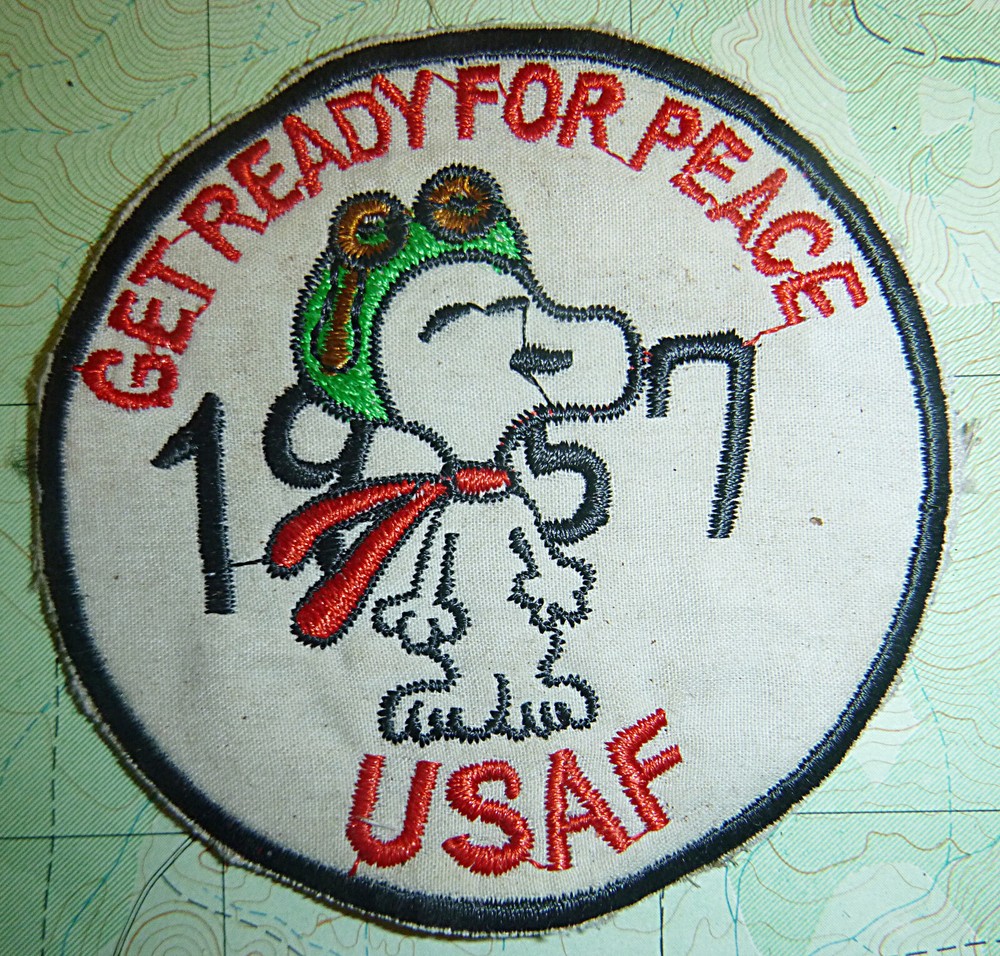
Check the listing for details. SNOOPY PATCH - Patch - Get Ready For Peace - USAF 1957 - Vietnam War - M.377. Condition: Used. Listed at 23.10 USD. Get Ready For Peace - US Air Force - Vietnam Snoopy Patch - 1957 - Pre Vietnam War United States Air Force - USAF Measures - 3.2 inches in diameter (8 cms) 1957 - Getting Ready For Peace The United States Air Force (USAF) in 1957 was undergoing a period of significant technological and organizational changes. Here are some key aspects of the USAF during that time:Cold War Focus: The USAF's primary focus in 1957 was on deterring and countering the Soviet Union during the Cold War. This involved maintaining a strong strategic nuclear deterrent and developing advanced aircraft and missile systems. Strategic Air Command (SAC): The Strategic Air Command was the major command responsible for the USAF's nuclear deterrence mission. It operated long-range bombers, such as the B-52 Stratofortress, and intercontinental ballistic missiles (ICBMs) to ensure the United States had the ability to deliver nuclear strikes if necessary. Missile Development: The late 1950s marked the beginning of the USAF's development and deployment of intercontinental ballistic missiles (ICBMs). The first operational ICBM, the Atlas, became operational in 1959. This marked a shift in the USAF's strategic capabilities, as it transitioned from relying solely on manned bombers to having long-range missile systems. Aviation Technology: In the late 1950s, the USAF introduced several significant aircraft. One notable example is the U-2 reconnaissance aircraft, which could fly at extremely high altitudes and provide valuable intelligence on Soviet activities. Additionally, the F-100 Super Sabre, an advanced supersonic fighter, entered service during this period.Space Exploration: The USAF played a significant role in early space exploration efforts. In 1957, the Soviet Union launched Sputnik, the world's first artificial satellite. This event prompted the U.S. to accelerate its own space program, leading to the establishment of the National Aeronautics and Space Administration (NASA) in 1958. Air Defense: The USAF was also focused on air defense during this time. It maintained a network of radar stations and interceptor aircraft to detect and intercept any potential Soviet bombers entering North American airspace. Normal 0 false false false EN-AU JA AR-SA
You may also like