| All returns accepted | ReturnsNotAccepted |
|---|---|
| Model | CMD 80 |
| MPN | CMD 80 |
| Brand | Tektronix |
| Type | Mobile Communication Test Set |
| Installed Options | B1, B14, B3, B60, B61, B62, B81, B82, B84, K1, K2 |
| Frequency Range | 824 MHz - 1990 MHz |
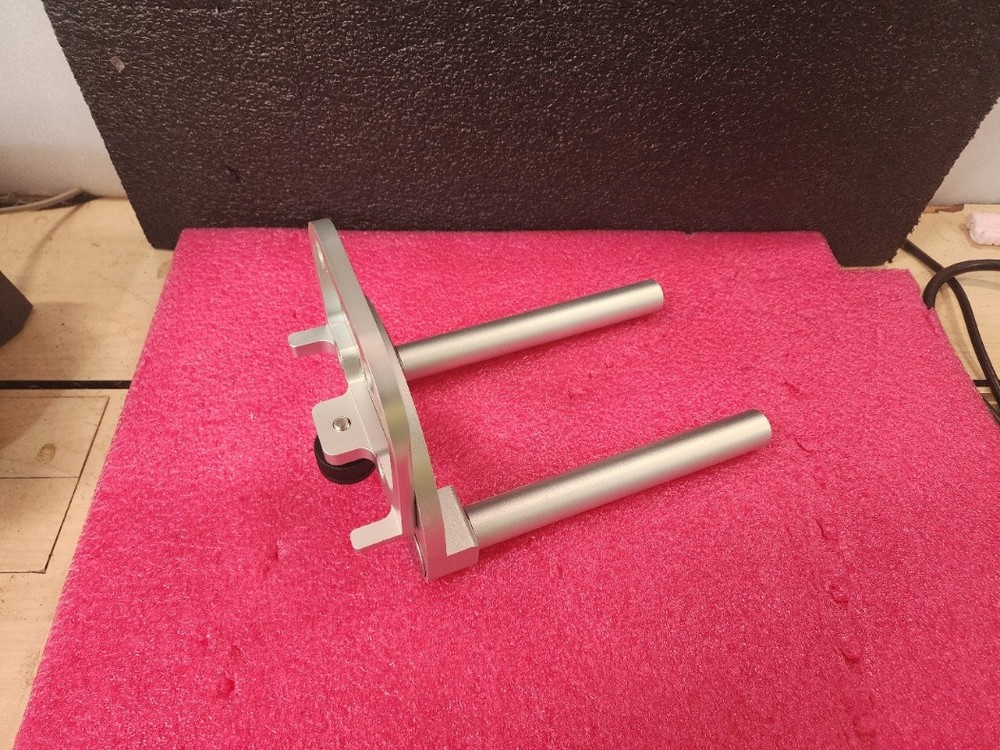
Check the listing for details. Tektronix/Rohde & Schwarz CMD 80 Digital Radio Test Set. Condition: Seller refurbished. Listed at 1999.99 USD. Rohde & Schwarz / Tektronix CMD80 Digital Radio Communication Tester Comes with a manual, power cord, and what you see in the pictures. If you don't see it, you probably wont get it. Specifications are from Tektronix and may vary slightly due to upgrades, options, or revisions this unit may or may not have. Picture shows not having option CMD B84, it didn't at the time of the picture, but has it now. The tester is guaranteed to work for 30-days, parts and labor, excluding freight. List Price was: $71800.00 new. Options: Opt. B1: OCXO reference oscillator. Ensures high absolute accuracy, minimum temperature-dependent drift and especially high long-term stability. Lists for $1035.00 Opt. B14: Rate Set 2 (13K) Vocoder. Lists for $2500.00 Opt. B3: Reference frequency input/outputs. Lists for $250.00 Opt. B60: Adapter ofr Opt. B61 and Opt. B62 (standard). Opt. B61: IEC/IEEE Bus interface. Lists for $345.00 Opt. B62: Memory card interface (standard). Opt. B81: AWGN Generator. Lists for $2500.00 Opt. B82: AMPS Support. Lists for $5000.00 Opt. B84: TDMA Support. Lists for $10000.00 Opt. K1: Adds cellular (standard). Opt. K2: Adds PCS. Lists for $8005.00 The Unit's Information Reads: Tektronix Serial Number: DE22758 Rohde & Schwarz Serial Number: 825078/048 Software Version: 3.2 1999/08/11 Description: The CMD80 is a multi-protocol mobile handset tester that is optimized for manufacturing test environments, attacking those areas that are most significant to a handset manufacturer; minimized capital expenditure, maximized speed/throughput and reduced test design time. To reduce capital expenditure, the CMD80 allows the handset manufacturer to create universal test lines. The CMD80 supports all of the following network types without the use of external modules: CDMA IS-136(NEW) AMPS NAMPS ETACS NTACS JTACS By creating universal test lines, the handset manufacturer reduces the amount spent on spares, training, manufacturing space and labor. The CMD80 provides maximum speed and throughput for the handset manufacturer. In benchmarks and in field trials, the CMD80 has been demonstrated to be as much as 20% faster than major competitors. This allows the manufacturer to produce more phones per dollar of labor and capital expense. The CMD80 also uses the concept of test "environments" that allow the CMD80 to execute tests using 1/6th of the code required for most testers. These environments allow the test programmer to define standard test parameter defaults that are used until they are redefined. Features & Benefits: Fast Measurement Times Large LCD Display Enhances the Friendly User Interface Minimal Coding Required Dual-mode CDMA/Analog Measurements Cellular and PCS Frequencies in a Single Test Set IS-136 Support Applications: CDMA Mobile Phone Testing AMPS Mobile Phone Testing TDMA Mobile Phone Testing By using the environment technique, the test programmer is not required to repeatedly reissue a laundry list of setup commands each time a test needs to be executed. This reduces the amount of test time overhead, the time required to construct test programs and the effort required to debug and support test programs. All of this adds up to more reliable testing for less environment. The CMD80 Digital Radio Communication Tester is a compact tester for CDMA, AMPS, TDMA and other mobiles. The mobile RF parameters are verified under similar conditions as found in a real network; i.e.; the tester simulates a base station, makes a call to the mobile and performs the measurements without any special test modes in the device-under-tester. In the CDMA mode the CMD80 measures several key IS 95 parameters using IS 98 methods: FER service option 2 Frame errors Waveform quality rho Error vector magnitude Phase error Magnitude error Carrier feedthrough Frequency Accuracy Power measurements Base station signaling for mobile testing Simulation of a Base Station: The CMD80 simulates a base station and provides all the signaling necessary to hold up a call: Synchronization of mobile Registration of mobile Incoming/Outgoing calls Handoffs During the call, the tester verifies the RF performance and checks the correct operation of the basic signaling features. The CMD80 does not rely on any special test modes in the mobile station and performs the measurements under conditions almost identical to those in the real network. A voice loop-back allows quick verification of mobile performance as it is perceived by the user. Easy to Use: The CMD80 is extremely user friendly and requires little detailed network knowledge. The large high-contrast liquid crystal display provides softkeys on both sides to allow convenient call-up of test routines under menu control. Easily, the user can switch to a menu and change the current settings of signaling and measurement parameters. The user is guided through the menus by explanatory text and may always return to the default setting with a push of a button. Fast Measurements: State-of-the-art digital technology leads to quick and efficient measurements for rho and power. In remote control mode via IEEE bus, the instrument is exceptionally fast and yields high throughput in production. Test Capabilities: All essential characteristics of a mobile station can be tested with high accuracy. The CMD80 not only verifies the RF performance of a mobile but, in addition, checks software features of the mobile which are important for the correct operation of the network. In many cases, this avoids the need for expensive custom test beds in development and QA. High Flexibility: Almost every signaling and measurement parameter can be modified by the user in the configuration menus, either dynamically during a test or in advance. Even the tolerances for pass/fail verdicts can be changed to match the requirements of the application. DC Measurements: The DC ammeter/voltmeter designed for pulsed signals allows correct measurement of the power consumption of the mobile station. Specifications: Signal Generator CDMA Frequency- Range: PCS U.S.: 1930 to 1990 MHz. PCS Korea: 1805 to 1870 MHz. U.S. Cellular: 869 to 894 MHz. Resolution: 1 Hz Error: same as timebase. Output Level- RF/In/Out: -20 to -132 dBm. RF Out2: 0 to -113 dBm. Resolution: 0.1 dB. Error (RF In/Out): < or = to 1.0 dB. Modulation- Carrier suppression: -30dBc. Analyzer CDMA Frequency- Range: PCS U.S.: 1850 to 1910 MHz. PCS Korea: 1715 to 1780 MHz. U.S. Cellular: 824 to 849 MHz. Japan Cellular: 887 to 925 MHz. Resolution: 1 Hz Error: same as timebase. Power Measurement- Reference level range: RF In/Out (full scale): +41 to -28 dBm. RF In2 (full scale): 0 to -69 dBm. Measurement error: Absolute: < or = to 1.5 dBm. Relative: < or = to 0.3 dB (reference level to -30 dB). Typical: < or = to 0.5 dB. Dynamic range: 50 dB below reference level. Modulation Analyzer- p error (25 ±10°C): 0.003 (for p 0.9 to 1). Frequency measurement range: 887 to 925 MHz. Frequency measurement error: 887 to 925 MHz. Timing measurement error: 887 to 925 MHz. Timebase- Standard: Nominal frequency: 10 MHz. Frequency drift (0 to 35°C): < or = to 1.5 x 10⁻⁶. Frequency aging: < or = 0.5 x 10⁻⁶/year (at 35°C). OCXO Refrequency Oscillator (Opt. CMD B1): Nominal frequency: 10 MHz. Frequency drift (0 to 35°C): < or = to 1.1 x 10⁻⁷. Frequency aging: < or = to 10-7/yr (< or = to 0.5 x 10⁹/day after 30 days operation). Warn up time (at 25°C): Approx. 5 minutes. Reference Frequency Input/Outputs Synchronization Input- Frequency: 1, 2, 5 or 10 MHz Impedance: Approx. 100 ohms. Level: 0 dBm to TTL. Synchronization Output- Frequency: 10 MHz or frequency at synchronization input. TTL, R(out): 50 ohms AWGN (Additive White Gaussian Noise) Generator Equivalent Noise Bandwidth: 18 MHz typical. Gain Adjustment Range: 20 to +6 dB of forward channel power. DC Voltage Measurements Range: 0 to ±30 V. Resolution: 10 mV Error: 2% resolution. DC Current Measurement Mode: Averaging, + peak, - peak. Range: 0 to ±A. Common-mode Rejection: ±30 V. Shunt Resistance: 50 mohms Resolution for Averaging: 1 mA/10 mA. Resolution for Peak:
You may also like